

The headwaters of the former drain the fertile Valley-and-Ridge Province, those of the latter the rugged and nutrient-poor Appalachian Plateau. Water quality in the upper Cumberland was severely impacted by 20th-century coal mining, the upper Tennessee much less so. Both rivers then enter the rich farmlands of the Interior Low Plateau and pass through unbroken chains impoundments to tiptoe north along the margin of the Coastal Plain, at the Cretaceous embayment of the Mississippi.
Between 1933 and 1979 the Tennessee Valley Authority constructed 49 dams in rivers of the Tennessee drainage, entirely impounding the main river and several of its larger tributaries. The US Army Corps of Engineers was charged with a similar program on the Cumberland River in the postwar years, ultimately completing an additional 10 dams. Today the Tennessee River is commercially navigable through locks and channels from its mouth to its origin one mile above Knoxville, and the Cumberland from its mouth to the Kentucky border at Celina.
The taxonomy and systematics of the diverse freshwater gastropod fauna inhabiting this 58,604 square mile region are more a function of human history than evolutionary process. Daniel Boone opened the Tennessee/Cumberland region to European settlement in 1775, over 100 years after the first Europeans set foot on the shores of what would become Boston, New York, and Philadelphia. These were a consequential 100 years malacologically, no less than in every other field of American endeavor.
The first natural history society in the New World was founded in Philadelphia in 1812, together with attendant museum and printing press. Thomas Say, the father of American Malacology, published his first paper in 1817 describing as he did all the common little brown snails of the rapidly urbanizing East. And in 1825, he sailed down The Ohio to Indiana, doing the same favor for the malacological fauna of the Midwest. Say, and indeed all the notable American scientists who were his peers, had first-hand experience with the Eastern and Midwestern subset of their native malacofauna.
But the Tennessee/Cumberland Region remained terra incognita to Eastern science well into the 19th century. Railroad connection was not made between Tennessee and Atlantic ports until 1857, almost immediately after which battle lines were drawn between the states, the South isolated, and its economy ruined. Very few centers of higher learning were established in the region until well after the war, and no natural history museums of any sort.
Malacologists working in the great Eastern centers of learning, such as Isaac Lea in Philadelphia, T. A. Conrad in New Jersey, and J. G. Anthony in Boston, relied on correspondents – often interested citizens of ambitious southern towns – to post dry shells to them in batches. Or indeed, engaged explorers to make collections as though the American South were darkest Africa. In the absence of any direct information about the habitat, range, morphological variation, or indeed any aspect of the biology of the living creatures they were competing against one another to describe, the taxonomy of the freshwater gastropods inhabiting the Tennessee/Cumberland region became a tangled mess.
Some of the confusion was cleaned up by 20th century monography, but much was not. Goodrich (1940), for example, catalogued approximately 380 specific and subspecific nomina of pleurocerid snails with ranges that might include tributaries of the Tennessee/Cumberland River system, approximately 100 of which he regarded as valid. These included approximately 40 species and subspecies of Goniobasis, 20 Pleurocera, 25 Lithasia, 5 Nitocris, 3 Anculosa, 2 Eurycaelon, and the 1 species of Io. Subsequent authorities have differed on the genus-level taxonomy, although Goodrich’s re-inventory of pleurocerid species has stood largely unexamined for 80 years.
And field surveys can be no
better than the taxonomy upon which they are based. The first
notable survey of the freshwater gastropod fauna of any river in the
Tennessee drainage was published in 1871, that of Miss Annie E. Law on
a 20-mile section of the main Holston River, communicated by Dr. James
Lewis. Lewis identified 20 species in Miss Law’s collections:
1 Physa, 1
ancylid limpet, 1 Somatogyrus,
1 Campeloma,
and 16 species of pleurocerids, in 6 genera. The most recent
field inventory of Tennessee freshwater gastropods was that of Pilsbry
and Rhoads (1896). Their list of 11 freshwater pulmonate and
28
prosobranch nomina was compiled from a single field survey conducted in
May and June of the previous year. Updating the taxonomy of
Pilsbry & Rhoads would shorten their list to a relatively
modest 20
prosobranch and 8 freshwater pulmonate species for the Volunteer State.
Bickel's (1968) review of the large, old, and scattered literature for the state of Tennessee returned a remarkable checklist of 98 freshwater gastropod nomina: 59 pleurocerids, 17 other prosobranchs, and 22 pulmonates. For comparison, the entire freshwater gastropod fauna of Atlantic drainages from Georgia to the New York line as confirmed by FWGNA survey totals just 69 valid species (Dillon et al. 2019).
Branson’s (1987) literature survey returned 60 freshwater gastropod species either “known from Kentucky” or “which should be here, but which have not been reported.” The field inventory of Branson & Batch (1982) confirmed just 22 freshwater gastropod species from the Cumberland drainages of Kentucky, however, with Branson et al. (1983) adding but two more.
In North Alabama, taxonomic confusion has been of such great magnitude and duration as to thwart field inventory entirely. The review of Garner & Johnson (2017) listed 70 nominal freshwater gastropod species apparently ranging through Tennessee drainages of Alabama, with another 10 species possible. Of those 80, 33 were pleurocerids. But no comprehensive field inventory of that malacologically-rich region has ever been published.
Against the malacological darkness that settled over the Tennessee/Cumberland region in the twentieth century were lit a few candles. Shoup's (1943) observations regarding the relationship between stream alkalinity and gastropod distribution in Tennessee were among the more influential early contributions to freshwater mollusk ecology. And 40 years of research on the Pleurocera clavaeformis populations at the Oak Ridge National Laboratory have added significantly to our understanding of stream ecology in general (e.g., Steinman 1991, Hill 1992, Rosemond et al. 1993, Hill et al. 2010). Grazing by populations of P. clavaeformis can have a significant impact on algal biomass, primary productivity, and periphyton community structure. For a review see Dillon (2000: 86 - 91).
> Methods
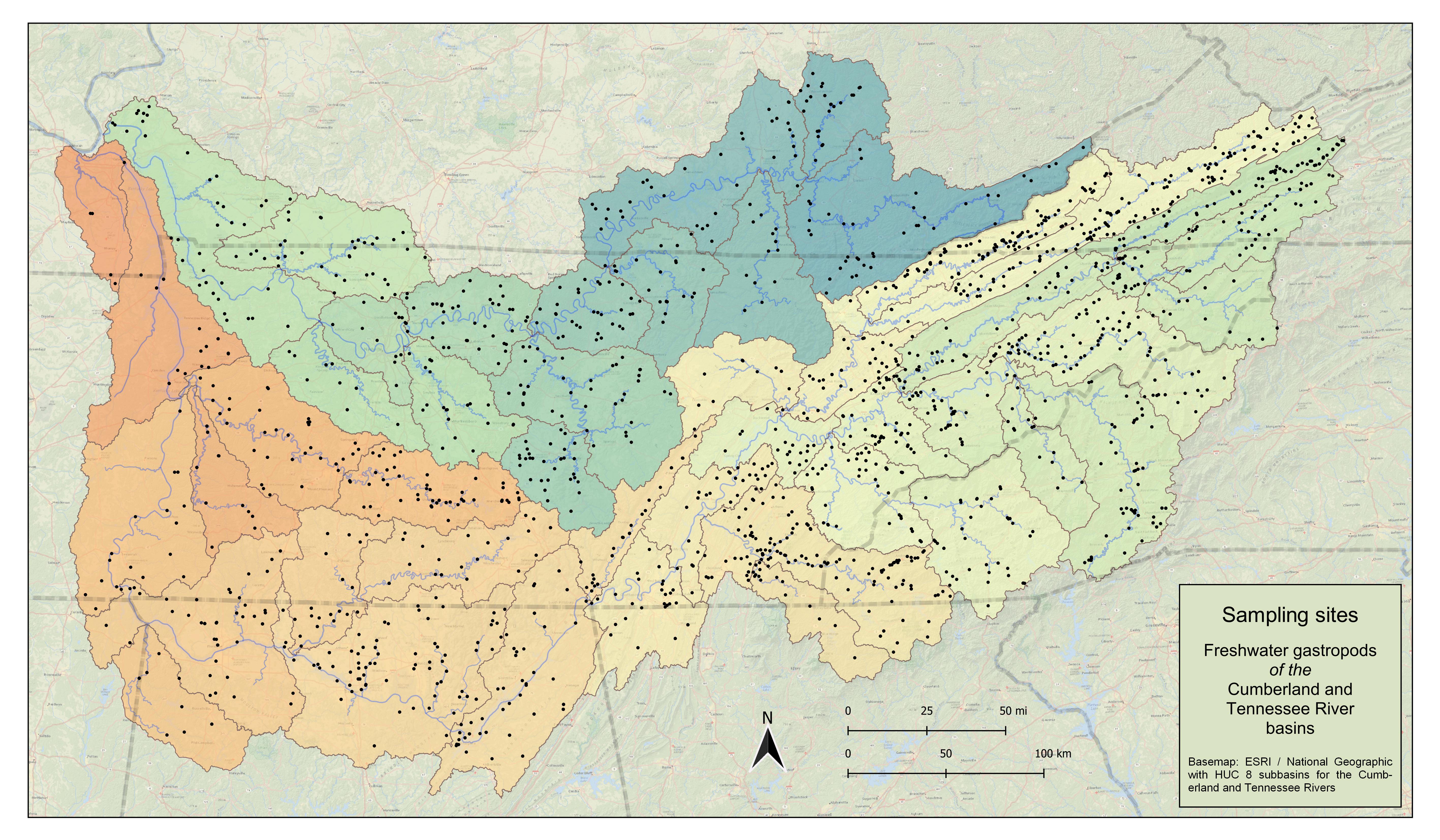
The database analyzed here comprises 4,003 records from approximately 1,700 discrete sites: 2,325 records in Tennessee, 326 in southern Kentucky, 553 in SW Virginia, 453 in North Alabama, 312 in western North Carolina, 40 in North Georgia, and 8 in far NE Mississippi collected 1955 – 2022. The largest fraction (56%) of our records are from personal collections, with state agencies contributing 34%, 8% coming from national museum collections, and 2% miscellaneous. See Table Tn1 for a complete accounting. Our entire 4,003-record database is available as an excel spreadsheet from the senior author on request.
Our personal collections were entirely qualitative, the result of simple untimed searches. Of these 1,863 records were made by RTD, 255 by MK, 35 by RW, and 98 contributed by Mr. Ryan Evans.
A total of 904 records were extracted from macrobenthic collections made 1996 – 2016 by the Tennessee Department of Environment and Conservation’s Division of Water Resources, with its cooperating agencies and organizations. The TNDEC-DWR coordinates a regular program of macrobenthic sampling in waterbodies selected around the state according to diverse criteria: antidegradation monitoring, total maximum daily loading studies, ecoregion reference, 303(d) fish and aquatic life monitoring, environmental field office watershed monitoring, and various special projects. Detailed methods have been published by TNDEC (2017).
Most of the TNDEC-DWR collections were made from riffles by the “SQKICK” method, one biologist holding a (double-handled) one-meter-wide kick net (500-micron mesh) and a second disturbing the substrate at the width of the net to approximately one meter upstream. Larger rocks are lifted and rubbed to remove clinging organisms. At least two such samples were taken at each site, more if it appeared to the biologists that 200 organisms had not been collected.
In waterbodies without riffle areas, the “SQBANK” method was employed. Here a triangular dip net with 500-micron mesh was jabbed underbank for a length of one meter at a minimum of three separate areas of reach, aiming to sample areas of different water velocity and substrate type, again to a total of 200 organisms. Macrophyte beds or snags may be substituted.
The bulk samples yielded by these collection methods, including associated silt, sand, cobble, and organic debris, were washed into wide-mouthed plastic containers with 80% ethanol. They were then transferred to the Tennessee Department of Health laboratory in Nashville where 200 organisms were randomly subsampled and identified. Remaining samples of unpicked bulk, collected in 2009, 2014, 2015, and 2016, were released to the FWGNA Project in three batches: 18May20, 14Jan21 and 4June21.
Ultimately, we picked a total of 684 bulk TNDEC samples, recovering gastropods from 372 unique sites in Tennessee/Cumberland drainages, yielding 869 records. We also added N=35 records from the reference collection maintained by taxonomists at the Nashville office 1996 – 1998.
The Kentucky Division of Water also conducts a great variety of macrobenthic surveys, including their Reference Reach Program (REF, targeted toward least-impacted sites), their Probabilistic Surveys (PRB, randomly chosen for trend analysis) land their Targeted Sites program (TMD, selected to calculate maximum daily load).
In high-gradient streams, KY-DOW personnel use a four-kick composite riffle sample plus a multihabitat sample taken with a D-frame net. The multihabitat component combines samples from woody debris, large boulders, emergent vegetation, leaf packs, depositional areas, and so forth. In low-gradient streams a 20-jab method is used, again with a D-frame net focused on the more productive habitats. Macrobenthic samples (regardless of purpose or method of sampling) are (generally) retained for five years. See Brumley et al. (2015) for details.
Review of the KY-DOW database returned 910 freshwater gastropod records sampled from 2010 – 2014, over all projects and methods, over all waters of the commonwealth. Our visits to the laboratories of the Kentucky DEP Division of Water in Frankfort in October 2016 and January 2017 added some samples collected as early as 2004. Most of these records were collected from drainages of The Ohio and are reported and analyzed on our FWGO web resource. But subtraction of duplicate samples and samples unidentifiable due to loss, breakage or juvenile size ultimately yielded 61 qualifying records from the Cumberland drainages under study here.
We included 176 freshwater gastropod records from the Virginia Department of Game and Inland Fisheries, transmitted to us by Mr. Brian Watson. These are collections and observations made by DGIF personnel and their contractors from Virginia drainages of the Tennessee 1988 - 2009. We also included 239 records collected from drainages of The Tennessee by NC Department of Water Quality 1985 – 2005 and housed at the North Carolina State Museum. The NCDWQ samples were semi-quantitative, taken by EPA standard methods, combining kick-nets, timed searches, and so forth (Barbour et al. 1999).
The museums contributing data to the present survey were, in
the order of their totals,
The
Florida Museum of Natural History (FLMNH, 154 records), the Ohio State
University Museum of Biological Diversity in Columbus (OSUM, 64
records), the Academy of Natural Sciences of Philadelphia, Drexel
University (ANSP, 51 records), the Virginia Museum of Natural History
(VMNH, 31 records), and others (USNM, INHS, NCSM) 16 records together.
Museum collections are typically biased in favor of larger and more conspicuous species (especially pleurocerids), species that are perceived to be rare or endangered, and invasive or accidental species, such as those collected on the margins of their ordinary ranges. A large fraction of most museum collections will be old, often with only approximate locality data, and although certainly of historic value, not useful for the modern survey that was our aim here.
We initiated all our museum surveys by carefully screening the collection databases, eliminating all undated lots or lots collected prior to 1955. We required that each museum record be plottable – with locality data of sufficient quality to permit the estimation of latitude and longitude coordinates. We then inspected each qualifying museum lot personally on site, to confirm its specific identification.
The taxonomy employed by the FWGNA project is painstakingly researched, well-reasoned and insightful. Needless to say, it often differs strikingly from the gastropod taxonomy in common currency among casual users and most natural resource agencies. First-time visitors looking for information about particular species or genera might profitably begin their searches with a check for synonyms in our alphabetical index.
> Results
The 70 species and subspecies of freshwater gastropods we have confirmed from waters of the Tennessee/Cumberland drainage system are listed in Table Bi1, both in [pdf] format and as a simple, sortable [excel] spreadsheet. They are figured in the FWGTN gallery and distinguished on the FWGTN dichotomous key. Ecological and systematic notes for each species and subspecies are provided on dedicated pages, together with regional distribution maps. Their distributions and abundances on a continental scale are analyzed in our sections on Biogeography and Synthesis.
> Acknowledgements
We especially wish to thank Mr. Ryan Evans, formerly of the KYDOW, both for his gracious assistance at the state shop in Frankfort, and for access to his personal collections. At the TNDEC-DWR we received invaluable assistance from Ms. Debbie Arnwine, Ms. Patricia Alicea, and Ms. Carrie Perry. Mr. Brian Watson of the VDGIF has been most forthcoming with data and supportive through all phases of this project. Some of the early surveys and genetic work were funded by the VDGIF through the USFWS State Wildlife Grant Program (contract 2006-9308).
The following colleagues graciously hosted us in the museums: John Slapcinsky at the FLMNH, the late Tom Watters at the OSUM, Gary Rosenberg, Paul Callomon, and Amanda Lawless at the ANSP, Art Bogan and Jamie Smith at the NCSM, and Bob Hershler and Chris Meyer at the USNM.
The success of this project has in large part depended on the great patience of web wizard Steve Bleezarde. Funded in part by a grant from the USDI-NPS Great Smoky Mountain National Park, Office of Inventory & Monitoring.
> References
Barbour, M., J. Gerritsen, B.
Snyder, & J. Stribling (1999)
Rapid bioassessment protocols for use in streams and wadeable rivers:
Periphyton, benthic macroinvertebrates, and fish, Second edition.
Washington, DC, US EPA 841-B-99-002.
Bickel, D. (1967)
Preliminary checklist of Recent and Pleistocene Mollusca of Kentucky.
Sterkiana, 28, 7-20.
Bickel, D. (1968)
Checklist of the Mollusca of Tennessee. Sterkiana 31: 15-39.
Branson, B.A. (1987)
Keys to the aquatic Gastropoda known from Kentucky. Transactions of the
Kentucky Academy of Science 48: 11-19.
Branson, B.A. &
D.L. Batch (1982) Molluscan distributional
records from the Cumberland River, Kentucky. The Veliger 24:
351 – 354.
Branson, B.A., J.B.
Sickel & B.M. Bauer (1983)
Notes on rare and endangered or threatened pleurocerid snails from the
Cumberland River, Kentucky. The Nautilus 97: 58 – 60.
Brumley, J., J. Schuster,
K. McKone, R. Evans, M. Arnold, A. Keatley, L. Hicks, & P.
Goodman (2015)
Methods for sampling benthic macroinvertebrate communities in wadeable
waters. Kentucky Department of Environmental Protection,
Division
of Water Document DOWSOP03003, 19 pp.
Dillon, R. T., Jr. (2000)
The Ecology of Freshwater Molluscs. Cambridge University Press,
Cambridge. 509 pp.
Dillon, R.T., Jr., M.J.
Ashton, W.K. Reeves, T.P. Smith, T.W. Stewart, & B.T. Watson
(2019)
Atlantic drainages, Georgia through Pennsylvania. Freshwater
Gastropods of North America, Volume 1. Bookbaby. 199 pp.
Discover Life in America-
All Taxa Biodiversity Inventory (2011) Great Smoky Mountain All Taxa
Biodiversity Inventory. http://www.dlia.org.
Gatlinburg,
Tennessee 37738.
Goodrich, C. (1940)
The Pleuroceridae of the Ohio River system. Occas. Pprs. Mus. Zool.
Univ. Mich. 417: 1-21.
Garner, J.T. and P.
Johnson (2017)
Freshwater Snails. Pp 4 – 42 in Shelton-Nix, E. (ed) Alabama
Wildlife, Volume 5. University of Alabama Press, Tuscaloosa.
Hill, W. (1992)
Food limitation and interspecific competition in snail-dominated
streams. Can. J. Fish. Aquat. Sci. 49: 1257-1267.
Hill, W., Smith, J.
& Stewart, A. (2010) Light, nutrients,
and herbivore growth in oligotrophic streams. Ecology 91: 518-527.
Lewis, J. (1871)
On the shells of the Holston River. American Journal of
Conchology 6(3): 216-226.
Pilsbry, H. &
Rhoads, S. (1896) Contributions to the Zoology
of Tennessee, Number 4, Mollusca. Proc. Acad. Nat. Sci. Phila. 1896:
487-506.
Rosemond, A., Mulholland,
P. & Elwood, J. (1993) Top-down and
bottom-up control of stream periphyton: effects of nutrients and
herbivores. Ecology 74: 1264-1280.
Shoup, C. (1943)
Distribution of fresh-water gastropods in relation to total alkalinity
in streams. The Nautilus 56: 130-134.
Steinman, A. (1991)
Effects of herbivore size and hunger level on periphyton communities.
Journal of Phycology 27: 54-59.
Stewart, T.W. &
R.T. Dillon, Jr. (2004)
Species composition and geographic distribution of Virginia’s
freshwater gastropod fauna: a review using historical records. American
Malacological Bulletin 19:79-91.
Tennessee Department of
Environment and Conservation,
Division of Water Resources (2017). Quality system standard
operating procedure for macroinvertebrate stream surveys.
DWR-PAS-P-01-QSSOP-081117. 266 pp.