

Both the Atlantic and the Gulf drainages of Georgia are covered, through the Florida panhandle... more

The four ecoregions of North Carolina drain toward the Atlantic through six major river systems... more

Although perhaps not as environmentally heterogeneous as neighboring states, South Carolina does include... more

The survey reported here is focused on the eastern 75% of the state, draining from the Blue Ridge to the Atlantic... more
All waters draining into the Tennessee River above the Alabama line, including SW Virginia, W North Carolina, and N Georgia... more

A study area of approximately 150,000 km2, including Delaware, Maryland, New Jersey, eastern Pennsylvania and the West Virginia panhandle... more

A survey of all waters draining into the Ohio River upstream from the mouth of the Tennessee/Cumberland at River Mile 920... more
> Habitat & Distribution
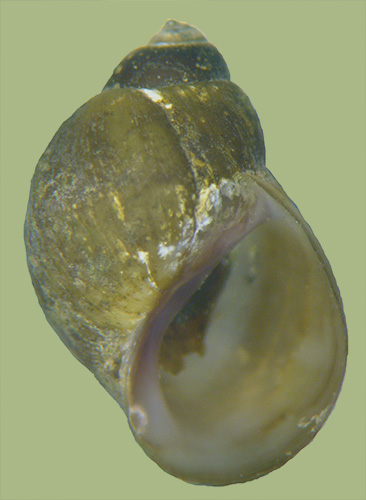
As a subspecies of P. potosiensis, Goodrich (1939) restricted the range of pleurocerid populations matching the ozarkensis phenotype to springs of Shannon, Carter, Washington, Dent, and Camden Counties, Missouri. Now understood as a subspecies of P. simplex, ozarkensis populations have been recognized throughout the Interior Highlands of southern Missouri, northern Arkansas, and eastern Oklahoma.
They maximum abundances in cold, rich, stable springs, spring runs, and creeks. Populations of P. simplex ozarkensis may co-occur with populations of P. potosiensis, from which they are often difficult to distinguish, with which (we speculate) they may hybridize.
Populations of typical P. simplex simplex are widespread in small, rich, hardwater streams from the upper New/Kanawha and Tennessee RIver drainages of SW Virginia across Tennessee and North Alabama to western Kentucky. Populations inhabiting larger and perhaps more nutrient-poor rivers of Kentucky and Tennessee bear paler, more robust shells and are identified as the subspecies P. simplex ebenum. The FWGNA incidence rank of all three subspecies considered together is I-5, very common.
> Ecology & Life History
Grazing by populations of pleurocerids can have a significant effect on energy flow in small streams (Dillon 2000: 86 - 91, see also Dillon & Davis 1991).
Jones and Branson (1964) have described the copulation and egg-laying habits of Ozark pleurocerid populations in great detail. In a wide-ranging study that almost certainly included both P. potosiensis and P. simplex ozarkensis, the authors observed a commencement of oviposition in early April, a peak in June, and a tailing-off by mid-July. Jones and Branson did not extend their observations to further details of the life history, but based on other pleurocerid populations in similar environments, it seems reasonable to expect that two years will be required for maturity, and that several years of iteroparous reproduction can be expected thereafter (Dazo 1965). This is life cycle Hi of Dillon (2000: 156 - 162).
> Taxonomy & Systematics
The study of Jones and Branson (1964) on the radula, genital system and external morphology of 4,331 individual Mudalia potosiensis sampled from 10 populations in Oklahoma, Missouri, and Arkansas is a hidden jewel of American malacology. Modern review of their locality data suggests that Jones and Branson may have included several populations of P. simplex ozarkensis among the potosiensis, but no matter. Their anatomical observations, which will apply uniformly to all North American pleurocerids as far as is known, trail only those of Dazo (1965) and Strong (2005) in their depth, detail, and rigor.
Pleurocera potosiensis populations demonstrate protean levels of shell morphological variation, both within and among populations, especially with regard to spire height and body whorl width. Goodrich (1939) recognized three subspecies on the basis of such variation: plebius (Anthony 1850), crandalli (Pilsbry 1890) and ozarkensis (Call 1886).
Minton et al (2011) confirmed a significant correlation between river position and spire height in populations he identified as P. potosiensis from the vicinity of Crystal Springs, Arkansas, downstream samples tending to demonstrate shorter, broader, more robust shells. Our 2025 resurvey of Minton's study populations has suggested that the Crystal Springs population might have been P. simplex ozarkensis. For more about this widespread and well-documented phenomenon, which we have termed cryptic phenotypic plasticity (Dillon et al. 2013, Dillon 2014) see essays 23Mar11, 3June13, and 11July14 from the links below.
Minton et al. (2017) went on to explore genetic variation within and among populations sampled at broad scale using 16S mtDNA sequence, and at fine scale using ISSR markers, very similar to the allozyme studies of Dillon (1984, 1988, 2020) with P. proxima. Although his fine-scale study returned no results, his survey of mtDNA sequence divergence in 61 individuals sampled from 31 populations yielded four strikingly-different clusters of haplotypes, each differing from all others by approximately 10%. One of those clusters turned out to mark populations previously described as Goniobasis ozarkensis by Call in 1886, subsequently demoted to subspecific status under potosiensis by Goodrich (1939), now understood as a subspecies of P. simplex.
See my essays of 7July26 and 3Aug26 from the links below for a review of my 2025 resurvey of the Minton et al. (2017) populations and an elaboration of the evidence that led to the recognition of P. simplex ozarkensis as a sibling species of P. potosiensis in the Interior Highlands.
This species has traveled through three genera in thirty years. Although predominantly assigned to Goniobasis through most of the 20th century, in the 1980s many workers began placing it in the resurrected generic nomen, "Elimia." Both Goniobasis and Elimia were subsumed under Pleurocera by Dillon (2011). See my essay of 23Mar11 from the link below for more.
> Maps and Supplementary Resources
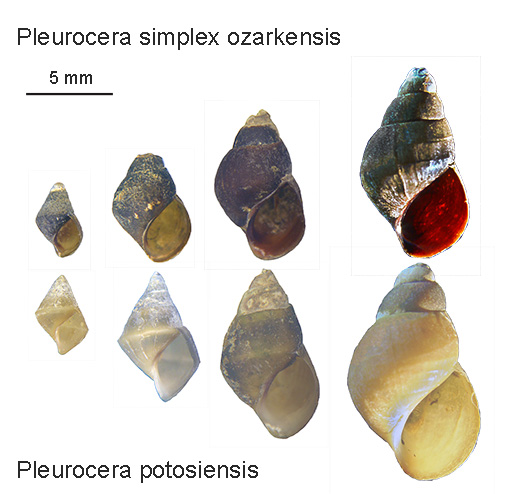
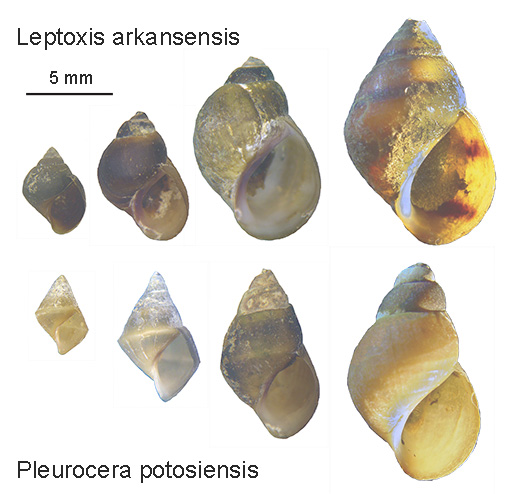
- Growth series comparing P. simplex ozarkensis to P. potosiensis.
> Essays
- Taxonomic controversy has surrounded the generic nomina Pleurocera, Goniobasis, and Elimia for many years. The best entry into the subject would be my essay of 23Mar11 on P. clavaeformis, entitled Goodbye Goniobasis, Farewell Elimia. Links are available from that essay to older resources.
- In my essay of 3June13 I documented another "Goodrichian taxon shift" in "Pleurocera acuta is Pleurocera canaliculata." This prompted my colleagues and me to broaden the concept of Goodrichian taxon shift and rechristen it "cryptic phenotypic plasticity."
- On 11July14 I posted an essay elaborating the results of my (2014) paper on cryptic phenotypic plasticity in P. semicarinata, entitled "Elimia livescens and Lithasia obovata are Pleurocera semicarinata." That essay also includes a couple additional figures of extreme shell morphologies.
- See my essay of 7July26, The peculiar pleurocerids of the Interior Highlands I: Pleurocera potosiensis for an introduction to the biogeography of the Ozark/Ouachita Highlands and its omnipresent regional endemic, P. potosiensis, with a review of the contributions of Minton et al. (2011, 2017).
- In my essay of 3Aug26, The peculiar pleurocerids of the Interior Highlands II: Pleurocera simplex ozarkensis, I report the results of my 2025 Ozark/Ouachita expedition confirming that Call's (1886) ozarkensis is not a subspecies of potosiensis, but rather a subspecies of P. simplex.
> References
Burch, J.B. (1989) North American Freshwater Snails. Malacological Publications, Hamburg, Michigan. 365 pp.
Call, R.E. (1886) Description of a new strepomatid mollusk of the genus Goniobasis. Bulletin of the Washburn Laboratory of Natural History (Topeka) 1(7): 189 190.
Christian, A.D. and D.M. Hayes (2007) Diversity and distribution of freshwater gastropods from the Ozark Region of Arkansas. Submitted to William R. Posey II, Malacologist and Commercial Fisheries Biologist, AGFC, P.O. Box 6740, Perrytown, Arkansas. 34 pp.
Dazo, B. C. 1965. The morphology and natural history of Pleurocera acuta and Goniobasis livescens (Gastropoda: Cerithiacea: Pleuroceridae). Malacologia 3: 1 - 80.
Dillon, R.T., Jr. (1984) Geographic distance, environmental difference, and divergence between isolated populations. Systematic Zoology 33:69-82. [PDF]
Dillon, R.T. Jr. (1988) The influence of minor human disturbance on biochemical variation in a population of freshwater snails. Biological Conservation 43: 137-144. [PDF]
Dillon, R. T., Jr. (2000) The Ecology of Freshwater Molluscs. Cambridge, Cambridge University Press. 509 pp.
Dillon, R. T., Jr. (2011) Robust shell phenotype is a local response to stream size in the genus Pleurocera (Rafinesque, 1818). Malacologia 53: 265-277. [pdf]
Dillon, R. T. Jr. (2014) Cryptic phenotypic plasticity in populations of the North American freshwater gastropod, Pleurocera semicarinata. Zool. Stud. 53:31. [pdf]
Dillon, R. T. Jr. (2020) Fine scale genetic variation in a population of freshwater snails. Ellipsaria 22(1): 24 - 25. [PDF]
Dillon, R.T. Jr. and K.B. Davis (1991) The diatoms ingested by freshwater snails: Temporal, spatial, and interspecific variation. Hydrobiologia 210: 233 - 242 [pdf]
Dillon, R. T., S. J. Jacquemin & M. Pyron (2013) Cryptic phenotypic plasticity in populations of the freshwater prosobranch snail, Pleurocera canaliculata. Hydrobiologia 709: 117-127. [PDF]
Goodrich, C. (1939). Pleuroceridae of the Mississippi River basin exclusive of the Ohio River. Occasional Papers of the Museum of Zoology, University of Michigan, 406, 1-4.
Gordon, M.E. (1980). Recent Mollusca of Arkansas with annotations to systematics and zoogeography. Proceedings of the Arkansas Academy of Science 34: 58-62.
Gordon, M.E. (1982). Mollusca of the White River, Arkansas and Missouri. Southwestern Naturalist, 27: 347-352.
Jones, W.C., & Branson, B.A. (1964). The radula, genital system, and external morphology in Mudalia potosiensis (Lea, 1841) (Gastropoda: Prosobranchiata: Pleuroceridae) with life history notes. Transactions of the American Microscopical Society, 83, 41-62.
Minton RL, Lewis EM, Netherland B, Hayes DM (2011) Large differences over small distances: plasticity in the shells of Elimia potosiensis (Gastropoda: Pleuroceridae). International Journal of Biology 3(1): 23-32.
Minton, R.L., B.L. McGregor, D.M. Hayes, C. Paight, and K. Inoue (2017) Genetic structuring in the pyramid Elimia, Elimia potosiensis (Gastropoda, Pleuroceridae), with implications for pleurocerid conservation. Zoosyst. Evol. 93(2) 437-449.
Strong, E.E. (2005) A morphological reanalysis of Pleurocera acuta Rafinesque 1831 and Elimia livescens (Menke 1830). The Nautilus 119: 119-132.
Wu, S-K, R.D. Oesch and M.E. Gordon (1997) Missouri Aquatic Snails. Missouri Department of Conservation Natural History Series No. 5, 97 pp.