

Table 1 [pdf, excel] shows that the 44 species and subspecies of freshwater gastropods we have here confirmed for the state of Missouri include 37 listed by Wu and colleagues (1997), often under multiple synonyms. We failed to confirm two species expected from the Wu et al. monograph: Pleurocera laqueata alveare and Birgella subglobosa. On the plus side, our fresh list includes seven species and subspecies that Wu did not catalogue: five pleurocerids, the crassulum subspecies of Campeloma decisum, and a single extralimital record of Helisoma scalare duryi.
The five new pleurocerids include Lithasia armigera armigera, Lithasia verrucosa, and Pleurocera canaliculata canaliculata, all restricted to the main Mississippi River. We here add two newly-recognized pleurocerid subspecies from the Ozarks to the Missouri list: Pleurocera canaliculata lawrencii and Pleurocera simplex ozarkensis.
> Regional Biogeography
These 44 species and subspecies are not all uniformly distributed across the state of Missouri. Four pulmonates are largely restricted to the glaciated prairie north of the Missouri River: Lymnaea elodes, L. caperata, L. cockerelli, and Physa jennessi. Four pleurocerids are restricted to the rivers and streams of the Ozark highlands: Pleurocera potosiensis, P. simplex ozarkensis, P. canaliculata lawrencii, and Leptoxis arkansensis. Four are characteristic of the main Mississippi River: Lithasia armigera, L. verrucosa, Pleurocera canaliculata canaliculata, and the viviparid Lioplax subcarinata. And four hydrobioids are obligate cave-dwellers: Amnicola stygia, Antrobia culveri, Fontigens antroecetes and F. proserpina.
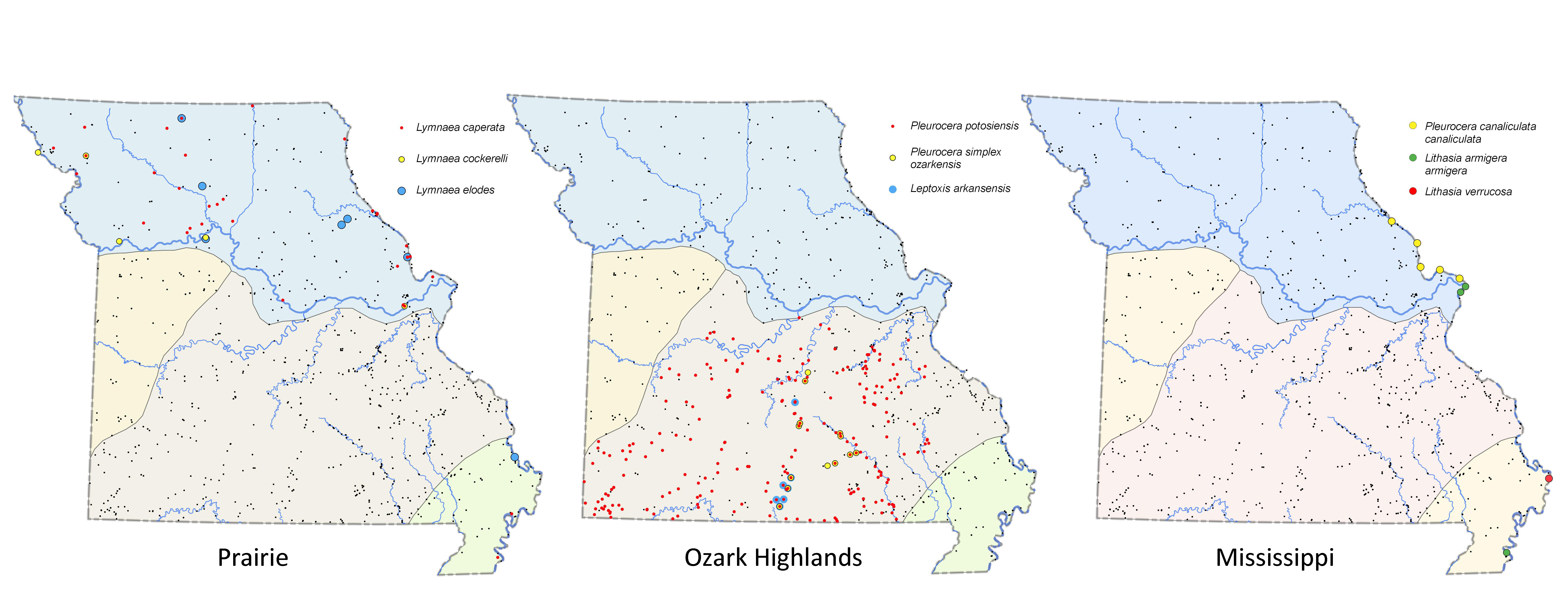

Figure 2. The regional freshwater gastropod fauna of Missouri. Click for larger.
These observations reinforce a generalization we first advanced on the FWGSC site in 2003, a generalization which has been confirmed by every other regional and continental analysis we have published since that date. Freshwater gastropod distributions are not typically constrained by riverine drainage systems, as depicted in Figure 1, but rather correlate with physiographic province.
> Abundance
Nor are the 44 freshwater gastropod species and subspecies of Missouri equally abundant. Table 1 shows that by incidence, Physa acuta was the most common species in the Show Me State, with 404 records. In stark contrast, four species were represented by but single records in our database, and the two additional species Wu and colleagues led us to expect seem to have been even more rare than that.
Like most other states in the union, Missouri has adopted the system of ranking by conservation concern developed by the NatureServe, both global (G ranks) and state (S ranks). The most recent list published by the Missouri Department of Conservation (MDC 2024) accords S1 ( critically imperiled ) status to eight freshwater gastropod nomina, and S2 ( imperiled ) status to four more.
Rather than speculate regarding such subjective concepts as imperilment, the FWGNA has adopted a simple system of ranking all freshwater gastropod species by their incidence in our (ever expanding) coverage region and dividing those species into quartiles. A fresh analysis of our entire database, now adding Missouri and the Great Plains states to our coverage of seven regions to the east, a total of 25,468 freshwater gastropod records of 127 species, is available here: FWGNA Synthesis v3.2.
> Continent-Scale Biogeography
On 12May22 we posted an analysis we entitled Biogeography v2.0, a review of freshwater gastropod distribution across all or part of 17 eastern states. And on 22Mar24 we compared a portion of that eastern fauna that of the Ohio (FWGO) and Tennessee/Cumberland (FWGTN), to the fauna of The Great Plains (FWGGP), skipping over Missouri entirely. Here we integrate our Missouri data together with our Great Plains data (FWGGP+FWGMO = West) and compare that western fauna to the freshwater gastropod faunas on the other side of the Mississippi River, FWGO and FWGTN.
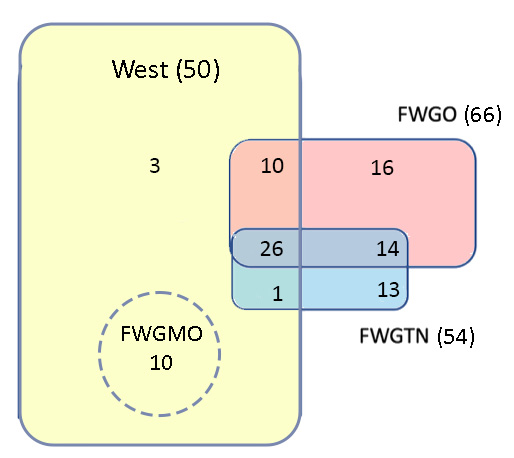
Figure 3. The distribution of 93 freshwater gastropod species inhabiting the Mississippi drainage.
As in our earlier biogeographic analyses, all subspecific nomina were collapsed into their parent species, yielding a total fauna of 93 biological species for the three regions combined. And following the precedent set for the Great Plains, we have constructed a boxy Venn diagram, the sizes of the three boxes scaled by the areal extent of each region: Ohio =144k mi^2, Tennessee = 58k mi^2, West = 378k mi^2.
The overall trend is one of decreasing species richness as the FWGNA Project has moved west. Although the area surveyed across the five Western states is double that of the Ohio and Tennessee/Cumberland combined, only 50 species of freshwater gastropods were identified in the west, compared to the 66 + 14 = 80 species in the FWGO and FWGTN.
Figure 3 shows that the Ohio drainage hosts 16 unique species, the Tennessee/Cumberland 13, and the much larger West 13 unique species. Of those 13, 10 are unique to Missouri, and just 3 unique to the Great Plains. The 10 Missouri species include 6 endemics: five hydrobioids and the pleurocerid Leptoxis arkansensis. In all these respects, given its relatively modest 70k mi^2 size, the species richness of Missouri is comparable to that of The Ohio and The Tennessee. But none of the 3 unique species of the Great Plains is endemic; all are more common further west. Thus, the notable reduction in species richness seen in The West more broadly would appear to be a phenomenon of The Great Plains alone.
Similar trends have long been remarked in almost all elements of the biota of North America, both terrestrial and aquatic. For plants and terrestrial animals, hypotheses to explain the lower biodiversity one observes as one travels westward from the Mississippi River toward the Rockies have generally focused on the reduction of precipitation. Such effects could only be indirect for the freshwater fauna but cannot be ruled out entirely. Extreme temperature fluctuations are also occasionally mentioned by biogeographers studying the terrestrial diversity of the Great Plains, but again, the freshwater fauna should be relatively protected.
We have suggested that the primary reasons for the reduced biodiversity of the freshwater gastropod fauna of the Great Plains are not environmental, but rather historical. In the FWGGP Discussion as published in 2024, we argued that two tightly linked, coequal factors seem to be involved. Our rationale is reviewed here.
The Late Cretaceous map of North America shows a Western Interior Seaway covering most or all of the modern states of Kansas, Nebraska, and the Dakotas, separating the island of Appalachia (Missouri and eastward) from Laramidia (Rockies and westward). Sea levels fluctuated across the Great Plains over the next 30 million years, not ultimately receding until the end of the Eocene.
The freshwater biota evolves slowly. Paddlefish strain plankton from the waters of the American interior even today, as sturgeon root bottom sediments for the larvae of dragonflies. Dillon and Robinson (2009) have reviewed evidence suggesting that the pleurocerid snails of the Southern Appalachians have not speciated since their origin in the Paleozoic. So, one of our co-equal hypotheses for the lower freshwater gastropod species richness observed in The Great Plains is that not enough time has passed since the seas have receded for endemic freshwater gastropod diversity to have evolved.
We further suggest that the absence of landform diversity is coequal with the absence of time as an hypothesis to explain the reduced diversity of the freshwater gastropod fauna of The Great Plains. The seas invaded the middle of North America during the Mesozoic Era because that region was flat, and that region has remained flat since the seas have receded. Landform diversity is among the chief hypotheses offered by continental biogeographers to explain the high species richness of the aquatic biota of the American Southeast, as compared to the homogeneous Great Plains, for example (Lydeard and Mayden 1995; Neves et al. 1997; Jenkins et al. 2015).
Protection from Pleistocene glaciation is also high on the list of hypotheses for the rich aquatic biodiversity of The Southeast, but if anything, evidence in The Great Plains is contrary. Much of the (relatively meager) landform diversity detectable in the Prairie today can be credited to the glaciers that covered most of North Dakota, half of South Dakota, and eastern slivers of Nebraska and Kansas. And our modern surveys find the richest freshwater gastropod fauna in North Dakota (23 spp), the poorest in Kansas (16 spp).
The element of landform diversity missing from the Great Plains is, of course, rock. With local exceptions (e.g., Black Hills of SD) the rivers that have developed since the Western Interior Seaway receded are not entrained by rocky hills and mountains; they shift on plains of clay and sand. They run broad and slow, carrying large volumes of sediment, especially during flood events.
A relatively modest 32 species comprise The Great Plains freshwater gastropod fauna, just 32/93 = 34% of the total combined fauna of the region under study here. The 93 - 32 = 61 species missing from The Great Plains are 54 prosobranchs and just 7 pulmonates. Prosobranchs, as a broad generality, require more dissolved oxygen than pulmonates, and are not as well-adapted to warmer temperatures or lentic environments. Populations of pleurocerid snails in particular are typically associated with riffles, rapids, and rocks. They are best adapted for grazing on solid substrate. They require solid substrate for egg laying.
We suggest that the absence of landform diversity rocky riffles in particular together with the absence of time for a regionally adapted fauna to evolve, accounts for the reduced freshwater gastropod diversity of The Great Plains.
> Acknowledgements
We owe special debts of gratitude to Randy Sarver and Dave Michaelson of the Missouri DNR for their invaluable assistance with state macrobenthic samples 2015 - 2018, their patience, and their great good humor. Steve McMurray of the Missouri Department of Conservation was also helpful with data in the early stages of this project.
We thank Jeremy Tiemann and Kevin Cummings for hosting us at the Illinois Natural History Survey back in 2017. Dr. Leanne Elder and Dr. Jingchun Li were especially gracious hosts at the University of Colorado Museum in 2021, and Kelly Rose Martin was subsequently helpful as well. We especially wish to thank Dr. Hsiu-Ping Liu and her family for a wonderful week in Denver, and Cousin Jenny Lou Fleming for her warm hospitality in Moberly.
The FWGMO web resource is dedicated to Dr. Shi-Kuei Wu, whose tireless efforts to catalogue the malacological diversity of Missouri both substantially inspired and materially facilitated the present effort.
> References
Dillon, R.T., Jr. (2000) The Ecology of Freshwater Molluscs. Cambridge University Press, 509 pp.
Dillon, R T. and J. D. Robinson (2009) The snails the dinosaurs saw: Are the pleurocerid populations of the Older Appalachians a relict of the Paleozoic Era? Journal of the North American Benthological Society 28: 1 - 11. [pdf]
Jenkins, C.N., Van Houtan, K.S., Pimm, S.L., and Sexton, J.O. (2015) US protected lands mismatch biodiversity priorities. Proceedings of the National Academy of Sciences 112(6): 5081 5086.
Lydeard, C., and Mayden, R.L. (1995) A Diverse and Endangered Aquatic Ecosystem of the Southeast United States. Conservation Biology 9(4): 800 805. doi:10.1046/j.1523-1739.1995.09040800.x
Missouri Department of Conservation (MDC 2024) Missouri Species and Communities of Conservation Concern Checklist. 71 pp.
Neves, R.J., Bogan, A.E., Williams, J.D., Ahlstedt, S.A., and Hartfield, P.W. (1997) Status of aquatic mollusks in the southeastern United States: A downward spiral of diversity. Pp. 43-86 in: Aquatic Fauna in Peril: The Southeastern Perspective (Benz GW, Collins DE, editors). Special Publication 1, Southeast Aquatic Research Institute, Lenz Design and Communications, Decatur, GA. Proceedings of a UMRCC symposium, 12-14 October 1992, St. Louis, Missouri. Upper Mississippi River Conservation Committee, Rock Island, Illinois.
Preston, F. (1948) The commonness, and rarity, of species. Ecology 29: 254 283.
Wu, S-K., Oesch, R. & Gordon, M. (1997) Missouri Aquatic Snails. Jefferson City: Missouri Department of Conservation. 97 pp.