
Both the Atlantic and the Gulf drainages of Georgia are covered, through the Florida panhandle... >> more
The four ecoregions of North Carolina drain toward the Atlantic through six major river systems... >> more
Although perhaps not as environmentally heterogeneous as neighboring states, South Carolina does include... >> more
The survey reported here is focused on the eastern 75% of the state, draining from the Blue Ridge to the Atlantic... >> more
All waters draining into the Tennessee River above the Alabama line, including SW Virginia, W North Carolina, and N Georgia... >> more
A study area of approximately 150,000 km2, including Delaware, Maryland, New Jersey, eastern Pennsylvania and the West Virginia panhandle... >> more
Marstonia ozarkensis
> Habitat & Distribution
This is another entry in the long list of small, obscure and poorly-known hydrobioid snails of North America. The range of Marstonia scalariformis seems to be strikingly disjunct, with a Midwestern focus and a Southern focus. In the former are populations inhabiting the Illinois, the Rock, and the Meramec Rivers of Illinois and Missouri, all draining into the Mississippi, with the lower Wabash River and Northern Indiana's Lake Maxinkuckee draining into The Ohio. In the southern focus are populations inhabiting the Flint River and Shoal Creek, draining into the Tennessee River of North Alabama, the latter population now apparently extinct. Our FWGTN database includes three records from the Flint and our FWGO database a single record from the lower Wabash River held by the Field Museum of Natural History.
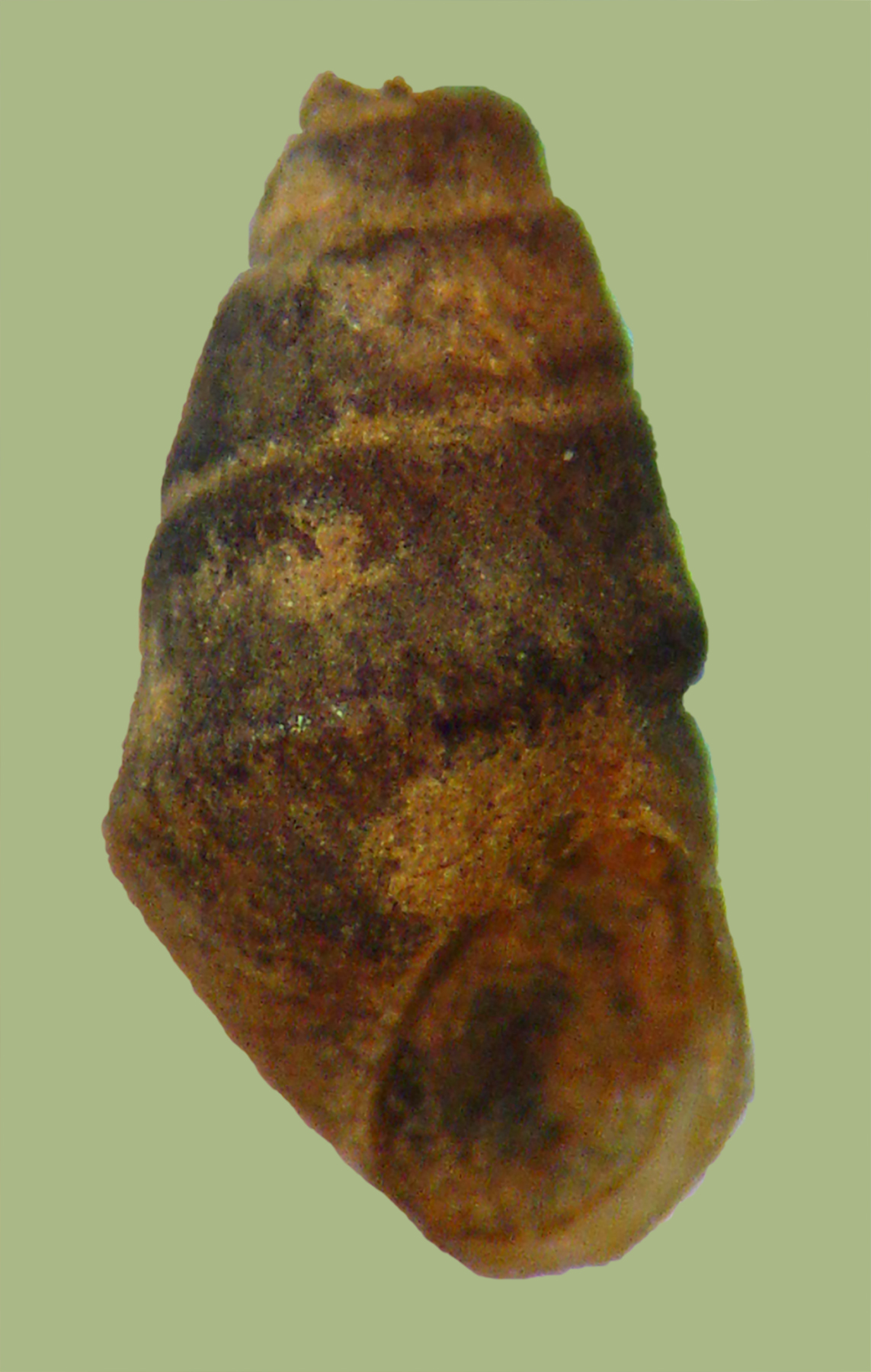
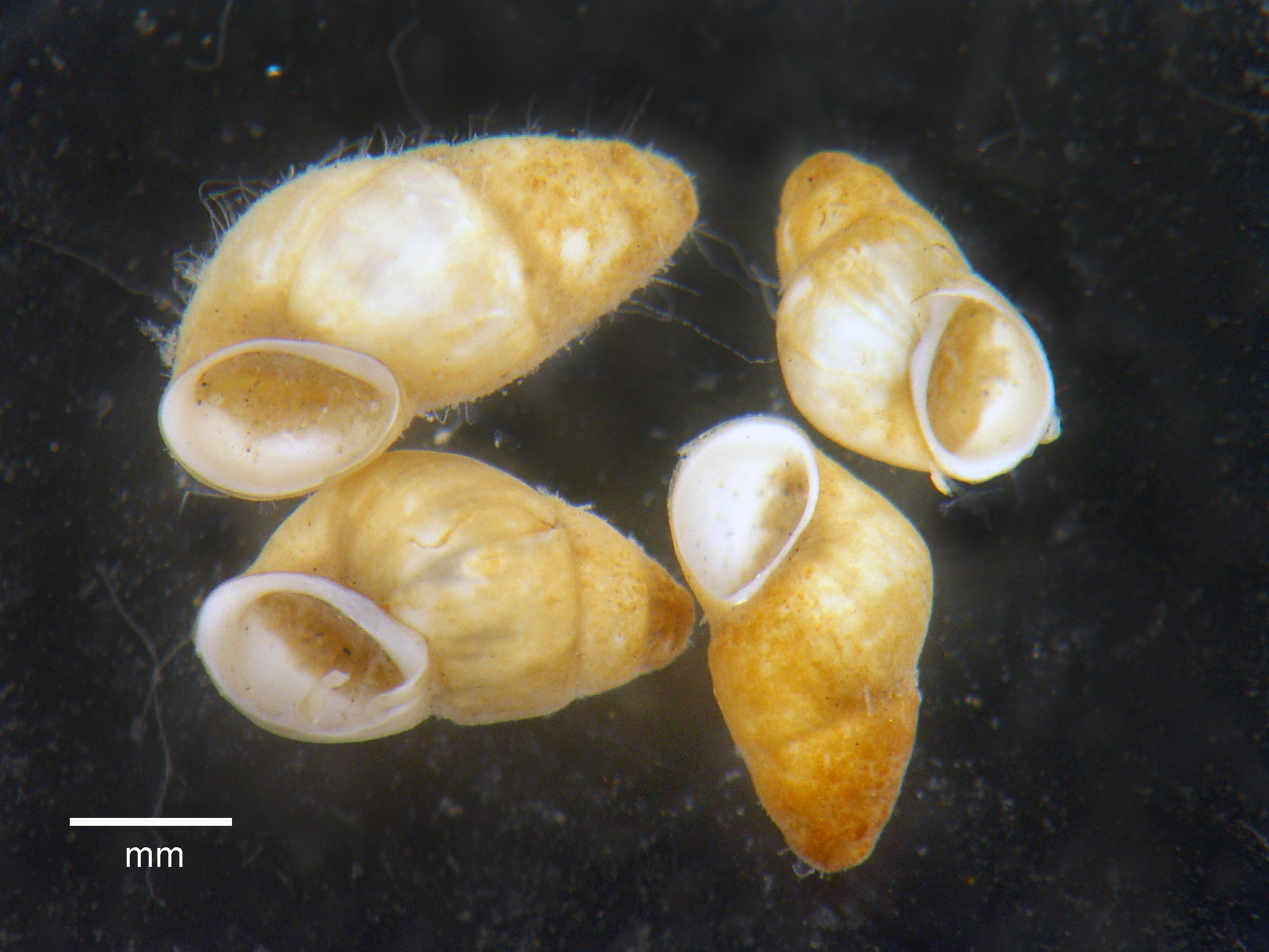
Our Missouri database includes a 1982 sample collected by M. E. Gordon from the North Fork of the White River in Ozark County, and a 1989 sample collected by MoDNR biologists from the Gasconade River in Maries County. Both of these were previously identified as Marstonia ozarkensis, which we here consider a junior synonym of M. scalariformis. See the supplementary photo below, and the links to my 2020 essays on the subject for a complete review.
In the lower Flint River, populations seem to reach maximum abundance in aquatic bryophytes sampled from waters of moderate current, washed into a white bucket. FWGNA incidence rank I-2, rare.
> Ecology & Life History
The cryptic habitat of Marstonia scalariformis seems to suggest a diet that does not ordinarily include algae, but rather very fine organic matter or bacteria. One might speculate that temperature, light, current, and other environmental factors in such a habitat would be fairly constant, suggesting constant (perhaps low) levels of reproduction year round. Hydrobiids are typically dioecious, the males being characterized by a penis that arises from the neck. Eggs are generally laid singly, attached in a spare capsule to a solid substrate.
> Taxonomy & Systematics
Pyrgula scalariformis was described by Wolf (1869) from a single empty shell collected along the Illinois River in Tazewell County, Illinois. In 1886 Call & Pilsbry described a new genus, Pyrgulopsis, to contain scalariformis and their own virtually-identical species from the Illinois bank of the Mississippi river at Rock Island, P. mississippiensis. Hershler (1994) considered both mississippiensis and wabashensis (Hinkley 1908) synonyms of scalariformis, the latter described from the Wabash River in Indiana, perhaps 200 miles southeast. All three nominal species have been considered extinct from their type localities by multiple authorities. Hershler made his anatomical observations from a population collected in the Meramec River of Missouri, perhaps 200 miles south of Wolf's type locality.
Pyrgulopsis scalariformis was transferred to the resurrected genus Marstonia by Thompson & Hershler (2002). Marstonia was subsequently retained in the Hydrobiidae (ss) by Wilke and colleagues (2013).
Given the high levels of intrapopulation shell morphological variation documented by Shimek (1892), negligible anatomical differentiation and similarity in overall biology, we have synonymized M. ozarkensis (Hinkley 1915) under M. scalariformis (Wolf 1869). We have retained M. letsoni as a valid species, primarily on the basis of ecological and habitat distinctions. See my 2022 essays from the links below for more about the elaborately entangled taxonomic history of these and other small narrow hydrobiids that have in common a carinate body whorl.
> Maps and Supplementary Resources
- Uncarinate shell form, Gasconade River, Maries County, MO.
> Essays
- For background info on the group of Marstonia that Thompson characterized to as "small narrow hydrobiids that have in common a carinate body whorl," see my essay of 4Oct22, The SNHTHICACBW Marstonia 5: scalariformis. That essay features a figure from Bohumil Shimek (1892) depicting variation in the whorl carination.
- See my essay of 3Nov22, The SNHTHICACBW Marstonia 6: pachyta, for a comparison between the letsoni/scalariformis subgroup and the pachyta subgroup.
- I explored the possibility that Marstonia ozarkensis, declared extinct by the USFWS in 2018, might have been a junior synonym of M. letsoni in my 2020 series: What was Marstonia ozarkensis? and Is Marstonia ozarkensis extinct? The latter essay also broached the possibility that both letsoni (Walker 1901) and ozarkensis (Hinkley 1915) might prove junior synonyms of Marstonia scalariformis (Wolf 1869).
- Earlier versions of this website, online until August of 2016, adopted the large, broadly-inclusive concept of the Hydrobiidae (sl) following Kabat & Hershler (1993). More recently the FWGNA project has shifted to the Wilke et al. (2013) classification system, distinguishing a much smaller Hydrobiidae (ss) and elevating many hydrobioid taxa previously ranked as subfamilies to the full family level. For more details, see The Classification of the Hydrobioids.
> References
Berry, E. G. (1943) The Amnicolidae of Michigan: Distribution, ecology, and taxonomy. Misc. Publ. Mus. Zool. Univ. Mich. 57: 1 - 68.
Call R. E. & Pilsbry H. A. (1886) On Pyrgulopsis, a new genus of rissoid mollusk, with description of two new forms. Proceeding Davenport Academy of Natural Sciences V.: 9-14.
Hershler, R. (1994) A review of the North American freshwater snail genus Pyrgulopsis (Hydrobiidae). Smithsonian Contributions to Zoology 554: 1 - 115.
Hinkley, A. A. (1908) A new species of Pyrgulopsis. Nautilus 21: 117-118.
Hinkley, A.A. (1915) New Fresh-water Shells from the Ozark Mountains. Proceedings of the United States National Museum, 49:587-589.
Shimek, B. (1892) Pyrgulopsis scalariformis (Wolf) Call and Pilsbry. Bulletin from the Laboratories of Natural History of the State University of Iowa 2: 168 - 174.
Thompson, F. G. & R. Hershler (2002) Two genera of North American freshwater snails: Marstonia Baker, 1926, resurrected to generic status, and Floridobia, new genus (Prosobranchia: Hydrobiidae: Nymphophilinae). The Veliger 45: 269 - 271.
Wilke T., Haase M., Hershler R., Liu H-P., Misof B., Ponder W. (2013) Pushing short DNA fragments to the limit: Phylogenetic relationships of "hydrobioid" gastropods (Caenogastropoda: Rissooidea). Molec. Phyl. Evol. 66: 715 - 736.
Walker, B. (1901) A new Amnicola. Nautilus 14: 113-114.
Walker, B. (1918) A synopsis of the classification of the fresh-water mollusca of North America, North of Mexico. University of Michigan Museum of Zoology Misc. Publ. 6: 1 - 213.
Wolf, J. (1869) Descriptions of three new species of shells. American Journal of Conchology 5: 198.