
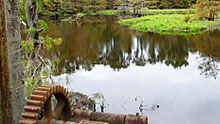
Both the Atlantic and the Gulf drainages of Georgia are covered, through the Florida panhandle... more
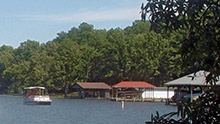
The four ecoregions of North Carolina drain toward the Atlantic through six major river systems... more
Although perhaps not as environmentally heterogeneous as neighboring states, South Carolina does include... more
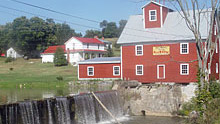
The survey reported here is focused on the eastern 75% of the state, draining from the Blue Ridge to the Atlantic... more
All waters draining into the Tennessee River above the Alabama line, including SW Virginia, W North Carolina, and N Georgia... more
A study area of approximately 150,000 km2, including Delaware, Maryland, New Jersey, eastern Pennsylvania and the West Virginia panhandle... more

A survey of all waters draining into the Ohio River upstream from the mouth of the Tennessee/Cumberland at River Mile 920... more
Leptoxis dilatata
> Habitat & Distribution
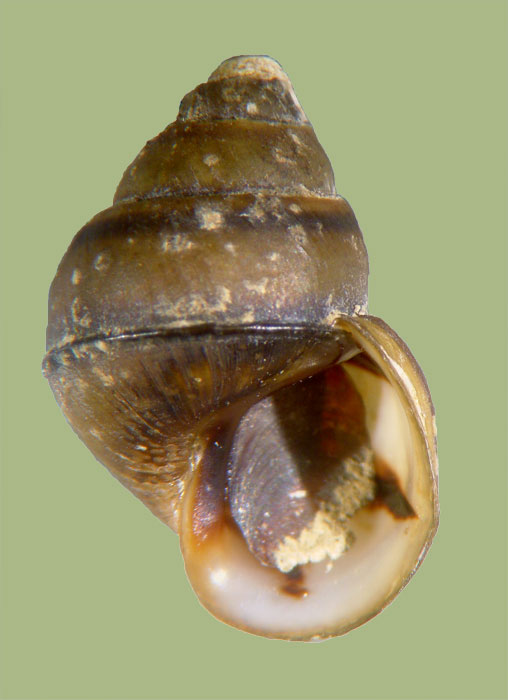
Populations of Leptoxis carinata range through Atlantic Coastal drainages from the upper Broad River drainage of North Carolina to the upper Susquehanna watershed of New York (Goodrich 1942, Parodiz 1956, Jokinen 1992). In drainages of The Ohio, an extensive population of L. carinata inhabits the New/ Greenbrier/ Kanawha drainage of NW North Carolina, southern Virginia, and central West Virginia (Dillon & Robinson 2009), with a second focus in the Tygart and Cheat drainages of the Monongahela. In drainages of The Tennessee, L. carinata populations co-occur with (ecologically similar) Leptoxis praerosa populations in Holston River tributaries of southwest Virginia and east Tennessee, and with Pleurocera catenaria populations in the upper Hiwassee. Within this wide range, populations reach maximum abundance in streams and rivers with moderate to strong current and abundant rocky substratum (Miller 1985, Stewart and Garcia 2002). FWGNA incidence rank I-5, very common.
Although populations of L. carinata are locally common throughout the Susquehanna drainage of central Pennsylvania, the species does not range into the environmentally-identical Delaware River system, running parallel to the Susquehanna over low ridges immediately to the east. This is by far the most striking example of an effect by river drainage across the entire 85-element freshwater gastropod fauna inhabiting the Atlantic watershed from Georgia to Pennsylvania. Given that the species ranges across seven major watersheds to the south, and indeed over the continental divide into the Ohio and Tennessee systems to the west, limited dispersal capabilities would not seem to offer an adequate explanation. Does the current distribution of Leptoxis carinata in Pennsylvania represent a relict of river drainage patterns as they existed at the Appalachian orogeny? See under "Taxonomy & Systematics" for more.
> Ecology & Life History
Stewart & Garcia (2002) reported that topographic complexity of substratum (i.e., rock abundance) was the primary cause of local variation in Leptoxis carinata densities and total biomass in a Virginia piedmont stream. Density and biomass were greatest in topographically complex plots with boulders and cobble that provide foraging habitat, as well as refuge from high-flow events. In such environments, Leptoxis carinata densities can exceed 500 individuals per square meter, or more than 80% of total macroinvertebrate biomass (Miller 1985; Stewart and Garcia 2002; Stewart and Dillon 2004). In addition to grazing on epilithic diatoms and other algae, L. carinata can obtain energy and nutrients through shredding leaves (Dillon & Davis 1991, Dillon 2000).
Population sex ratios are variable, but tend toward female bias (Cipiaris et al. 2012). Aldridge (1982) and Jokinen (1992) reported semelparous reproduction in northern populations of L. carinata, adults maturing in two years (life cycle Hs of Dillon 2000:156-162), although iteroparous reproduction (Hi) seems more likely in the south. The data on reproductive energetics developed by Aldridge (1982) suggested to Dillon (2000: 126 136) that New York populations of L. carinata are USR Undifferentiated with respect to life history adaptation.
Eggs are deposited on hard substrates in the spring or summer, singly or in masses up to an average of several hundred. Whelan and colleagues (2015) described eggs as being laid "in a non-random linear pattern" under their culture conditions.
Ciparis et al. (2013) reported generally low trematode infection rates in populations of L. carinata inhabiting 15 different Shenandoah River tributaries, five different families of trematodes involved.
> Taxonomy & Systematics
Parodiz (1956) offered a striking figure of the shell morphological variation in a single population of L. carinata from the Smith River, Virginia. Such variation has doubtless been responsible for a proliferation of synonyms, which include dissimilis (Say, 1819), nickliniana (Lea, 1841), variabilis (Lea, 1841), and corpulenta (Anthony, 1860). Trans-Appalachian populations of L. carinata have been referred to as L. dilatata (Conrad, 1835) in the New/Kanawha drainage and (sometimes) as L. virgata in the Holston/Tennessee, although that nomen has more recently been applied to a sibling species of L. praerosa.
A great variety of generic nomina have also been suggested to contain L. carinata over the years, including Anculosa, Spirodon, Nitocris, and Mudalia (Goodrich, 1942; Parodiz, 1956). See the pair of 2023 essays I published from the links below for a review of my 50 years of field experience with pleurocerid populations of the genus Leptoxis, integrated together with the 2013 molecular phylogeny of N. V. Whelan.
Dillon & Robinson (2009) nominated L. carinata as one of the "snails the dinosaurs saw," suggesting on the basis of DNA sequence data that populations of these snails may date to the Appalachian orogeny (see my essay of 16Mar09 from the link below.) Their analysis also suggested the nomen Leptoxis dilatata (Conrad 1835), applied for many years to trans-Appalachian Leptoxis populations in the New River, is a junior synonym of L. carinata. The dilatata at synonymy was subsequently confirmed by the molecular analyses of Whelan (2013) and Whelan et al. (2022). See my essays of 9May23 and 13Nov25 from the links below for more.
> Maps and Supplementary Resources
- Leptoxis distribution in drainages of The Ohio (2019)
- Leptoxis distribution in Atlantic drainages (2023)
- Leptoxis distribution in the Tennessee/Cumberland (2022)
- Virginia species account with county distribution (2011)
- Leptoxis carinata in the South Fork Shenandoah River, courtesy of Alan Cressler.
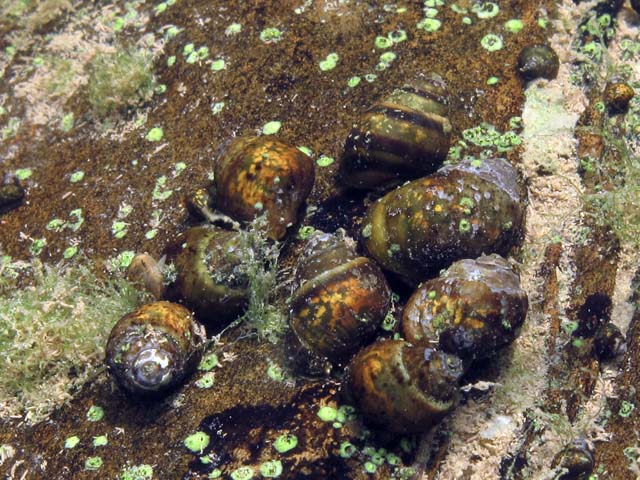
- Pretty photo of living L. carinata, courtesy of Chris Lukhaup.

> Essays
- See my FWGNA post of 16Mar09, The Snails The Dinosaurs Saw, for more on the genetics, taxonomy, and distribution of Leptoxis carinata.
- I reviewed my 50 years of field and laboratory experience with pleurocerid populations of the genus Leptoxis in a blog post of 6Apr23, Growing up with Periwinkles. That essay featured a nice photo of L. carinata covering the rocks in the Jackson River of Virginia, a scan of Parodiz' classic (1956) figure of shell variation in the Smith/Dan R, and a (slightly less-classic) figure of New River "dilatata" populations from my undergraduate honors thesis of 1977.
- See my essay of 9May23, Testing the Periwinkle Hypothesis, for an appreciation of N.V. Whelan's impressive (2013) DNA sequence data set drawn from 31 populations of Leptoxis sampled across eastern North America. Among the many important results of Nathan's phylogenetic analysis was confirmation that New River populations previously assigned to L. dilatata are conspecific with Atlantic L. carinata. My 9May23 essay also featured a pretty photo of L. carinata eggs in situ.
- The evolutionary relationships among all six of the biological species of the genus Leptoxis were wonderfully revealed by the AHE phylogenomic study of Whelan et al. (2022). For a review, see my post of 13Nov25, Anchored hybrid enrichment, Leptoxis lessons, and the advice of Queen Elsa.
> References
Aldridge, D.W. 1982. Reproductive tactics in relation to life-cycle bioenergetics in three natural populations of the freshwater snail, Leptoxis carinata. Ecology 63:196-208.
Brown, K.M. 2001. Mollusca: Gastropoda. In: J.H. Thorp and A.P. Covich, eds., Ecology and Classification of North American Freshwater Invertebrates, Academic Press, New York. Pp. 297-329.
Cipiaris, S., W. F. Henley and J.R. Voshell (2012) Population sex ratios of pleurocerid snails (Leptoxis spp.): Variability and relationshps with environmental contaminants and conditions. Amer. Malac. Bull. 30: 287 - 298.
Ciparis, S., D.D. Iwanowicz and J.R. Voshell Jr. (2013) Relationships between nutrient enrichment, pleurocerid snail density and trematode infection rate in streams. Freshwater Biology 58(7):1392-1404.
Dillon, R.T., Jr. 2000. The Ecology of Freshwater Molluscs. Cambridge University Press, Cambridge, United Kingdom.
Dillon, R.T., and K.B. Davis. 1991. The diatoms ingested by freshwater snails: temporal, spatial, and interspecific variation. Hydrobiologia 210: 233-242.
Dillon, R.T., and J.D. Robinson. 2009. The snails the dinosaurs saw: Are the pleurocerid populations of the Older Appalachians a relict of the Paleozoic Era? J. N. Am. Benthol. Soc. 28: 1-11.
Goodrich, C. 1921. Anculosae north of the Alabama drainage. Nautilus 35:9-12.
Goodrich, C. 1940. The Pleuroceridae of the Ohio River drainage system. Occas. Pprs. Mus. Zool. Univ. Mich., 417: 1-21.
Goodrich, C. 1942. The Pleuroceridae of the Atlantic coastal plain. Occas. Pprs. Mus. Zool. Univ. Mich., 456, 1-6.
Jokinen, E.H. 1992. The Freshwater Snails (Mollusca: Gastropoda) of New York State. NY State Mus Bull 482, Albany, New York.
Miller, C. 1985. Correlates of habitat favourability for benthic macroinvertebrates at five stream sites in an Appalachian mountain drainage basin, USA. Freshw Biol 15:709-733.
Parodiz, J. J. 1956. Notes on the freshwater snail Leptoxis (Mudalia) carinata. Annals of the Carnegie Museum 33: 391 - 405.
Stewart, T.W., and R.T. Dillon, Jr. 2004. Species composition and geographic distribution of Virginia s freshwater gastropod fauna: a review using historical records. Amer Malac Bull 19:79-91.
Stewart, T.W., and J.E. Garcia. 2002. Environmental factors causing local variation in density and biomass of the snail Leptoxis carinata, in Fishpond Creek, Virginia. Amer Midl Natur 148:172-180.
Whelan, N.V. (2013) Conservation, life history and systematics of Leptoxis Rafinesque 1819 (Gastropoda: Cerithioidea: Pleuroceridae). Ph.D. Dissertation, University of Alabama, Tuscaloosa. 179 pp.
Whelan, N. V., P.D. Johnson and P. M. Harris (2015) Life-history traits and shell morphology in the genus Leptoxis Rafinesque, 1819. J. Moll. Stud. 81: 85-95.
Whelan, N.V., P.D. Johnson, J.T. Garner, N.L. Garrison, and E.E. Strong (2022) Prodigious paraphyly in Pleuroceridae (Gastropoda: Cerithoidea). Bulletin of the Society of Systematic Biologists 1(2). https://doi.org/10.18061/bssb.v1i2.8419